
AI SEO
approx 9 minute read
How to get your brand ready for answer engines
It’s a new era of search. AI SEO. GEO. AEO. LLM optimisation. Generative search. Answer engines. Lots of names. Same idea.
Search is evolving. Not disappearing. Not being replaced. Just getting bigger. Broader. And a bit more human (ironically).
People still type stiff robotic queries into Google, because old habits die hard.
Yet at the same time, millions of us are now asking long, rambling, deeply personal questions inside AI tools.
Full stories. Follow-ups. Clarifications. Layers of context that would have seemed bizarre in a Google search bar five years ago.
It’s still search. Just next level. And it needs a fresh approach.
So… what actually is AI SEO?
AI SEO is traditional SEO with a shiny new coat of paint. Same foundations. Same principles. Helpful content. Quality links. Fast websites. Clean structure…
But AI SEO adds something new. It focuses on how AI systems understand your content. Not just search engines. But answer engines like ChatGPT, Perplexity, Gemini and Claude.
These tools scan the web, collect facts, look for patterns, then generate answers. Often with citations. Sometimes without.
AI SEO is about getting mentioned and/or cited inside those answers.
People aren’t abandoning Google
But we are not witnessing the “Death of Google.”
Traditional search is still the heavyweight. Month after month.
People still type things like “ski jacket sale”, “pizza near me”, “best accountants Birmingham”.
Short, functional queries remain the backbone of search behaviour, and they aren’t going anywhere.
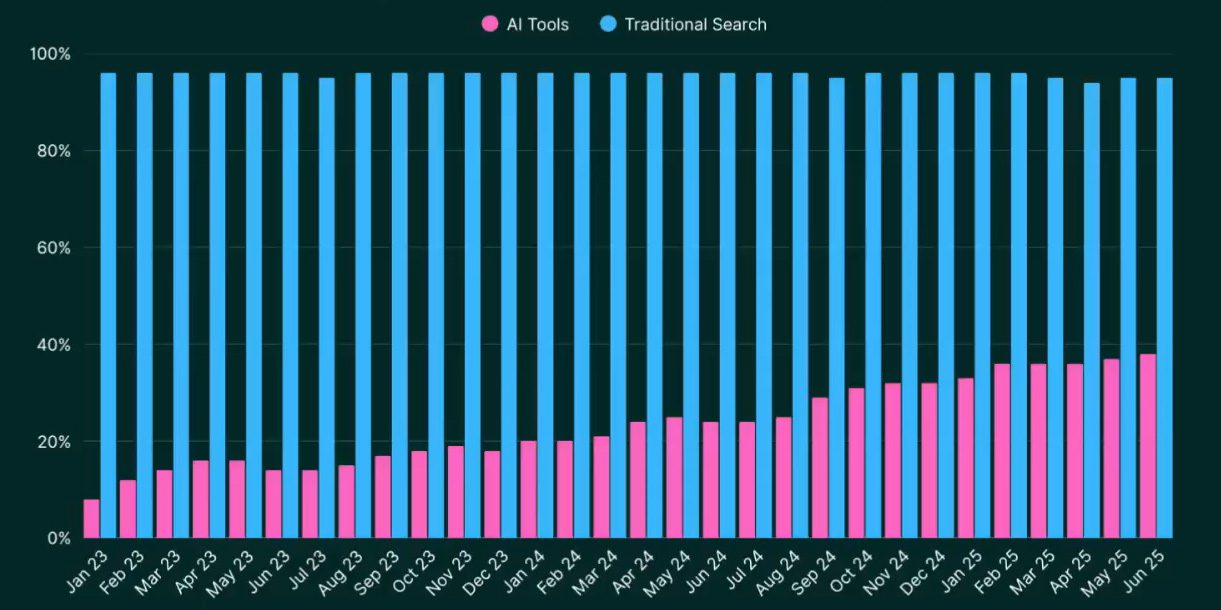
Check out this data from SEMrush which covers Answer Engine uptake in the US. The ‘Traditional Search’ blue bars towering over everything else.
Like we said in an earlier blog post on the Search Everywhere Optimisation, AI search isn’t ‘instead of’ it’s ‘in addition to‘. But it’s catching up.
Many experts believe we will hit usage parity as early as 2028. Which is wild considering how dominant Google has been for almost 30 years.
But people are also asking wild, hyper-specific questions
Here’s where things get interesting. Alongside those classic searches, AI tools are exploding in usage.
Not replacing search. Just adding to it. And people behave very differently inside them. They ask things like: “What’s the best ski jacket for someone who travels light, hates being cold, sweats a lot, looks terrible in red, and wants something under £200?”
Then they ask for cheaper alternatives. Then they ask for a table. Then they ask whether those jackets will fit someone with broad shoulders.
This kind of conversational chaining didn’t exist before. Now it’s normal. AI search is becoming a second stream of discovery. And SEO now needs to cover both.
Prompts vs Keywords
This is the shift. Traditional SEO focuses on keywords. “Ski jacket.” “Kitchen renovation.” “Dog-friendly hotel Liverpool.”
AI tools focus on prompts. Prompts contain intent and context. “What’s the warmest waterproof ski jacket for a beginner who gets cold easily and only travels hand luggage?”
That’s a prompt. And AI systems love context.
Your content must now work for both worlds. Clear keywords for traditional search. Natural, contextual explanations for AI search.

What’s changed in Search
If we could sum it up in one word, it’d be ‘Context‘.
SEO was always about relevance. But now? Bonus levels.
For example, HubSpot updated one of their buyer personas from ‘Marketing Manager Margaret’ to Marketing Manager Margaret (who works in a logistics company in Ireland employing 200 people)
So, how relevant can you be now? And once you can provide hyper relevant content, what helps this get noticed?
The new bits:
- AI crawlers behave differently. They can’t execute JavaScript
- Pop-ups and overlays block them
- They skim content very quickly
- They might not read the whole page, missing earlier info
- They care even more about server speed
- Schema helps them understand meaning
- They prefer clean sentences, natural structure and clear context
The old bits:
- Good content still wins
- Authority still matters
- Links still count
- Structure still helps
- Website speed still matters
- Brand trust remains everything
Even Google says it. Good SEO is good AI optimisation. Most of the fundamentals still apply. You’re just tweaking few new knobs. Are we allowed to say that?
What does “winning” look like now?
Traditional SEO has a familiar goal. Appear in search results. Earn a click. Make a sale.
AI SEO has two goals: getting quoted and earning the citation link.
1. Appear in AI-generated answers
When an LLM repeats your facts, echoes your phrasing, or includes your brand name, you build awareness in a powerful new channel.
2. Earn the link
Some answer engines show sources. A link from one of these tools can send extremely high-intent visitors.
How backlink acquisition has changed
This part of SEO looks different now too. Before, offsite SEO often meant writing articles for third-party sites that were related to your topic.
You’d explore something adjacent, weave in a subtle link, and craft clever descriptive anchor text. It wasn’t spam. But it wasn’t exactly fan mail either. It was strategic. Lateral. And very normal.
Fast forward to today. LLMs like things much more direct.
They want to see:
- Comparison pages that mention your brand
- Articles actually written about your business
- Lots of brand mentions
- Clear references to your expertise
- Third-party reviews and advertorials
LLMs reward clarity. They reward repeated brand exposure. They reward being named, referenced and compared.
This means brand-heavy link building and structured mention acquisition have far more value than they perhaps did previously.
How to optimise for answer engines
Start with the basics.
Solid SEO. Clean foundations.
Then layer in the AI-friendly tactics…
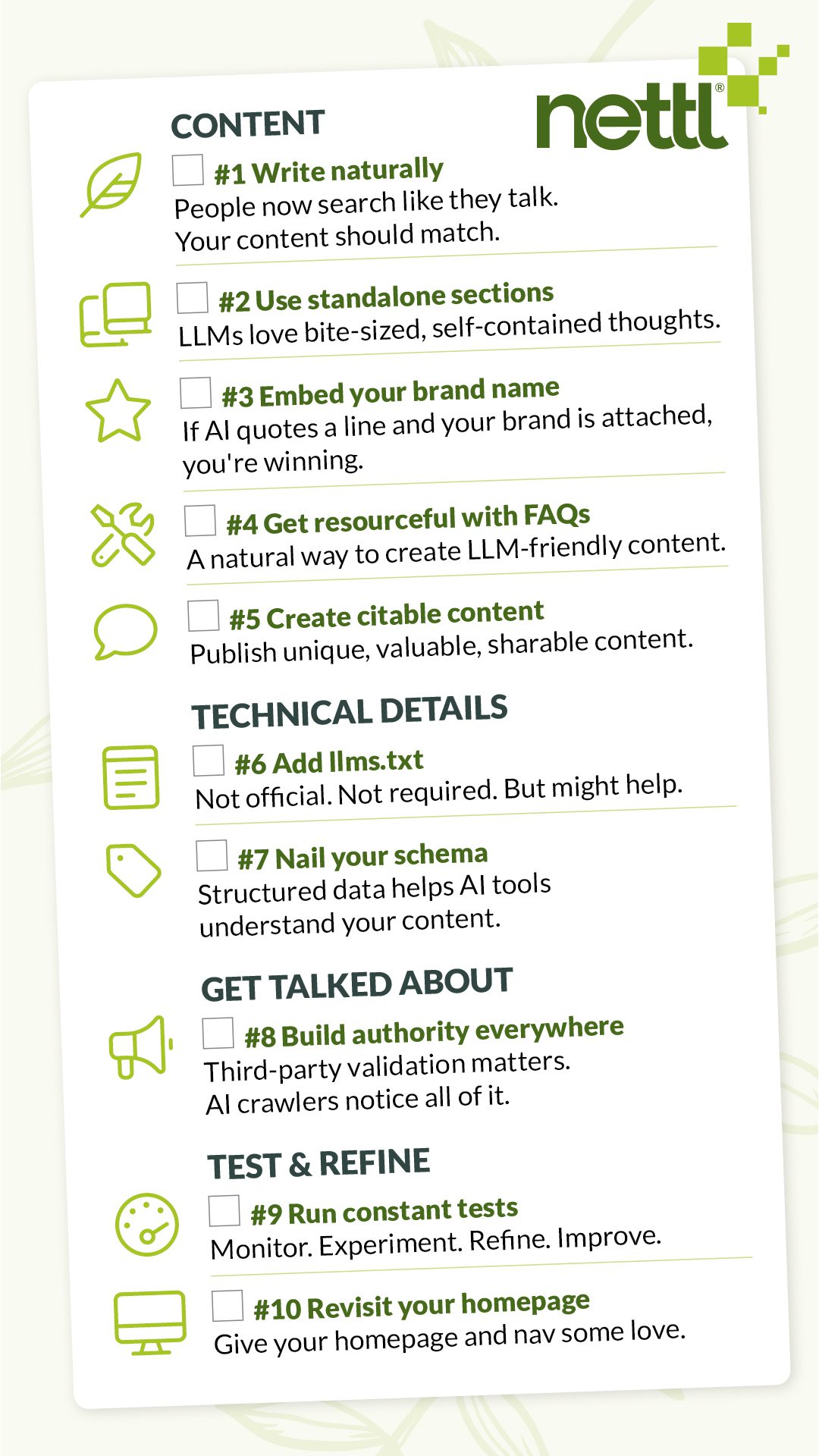
#1 Write naturally
This is already the Nettl way. Short sentences. Clear tone. People now search like they talk. So your content should match.
#2 Use standalone sections
LLMs love bite-sized, self-contained thoughts. Labelled sections that make sense on their own get quoted more. Think micro-answers.
#3 Embed your brand name
If AI quotes a line and your brand is inside it, you win by association. The name travels with the idea.
#4 Get resourceful with FAQs
Write headings as questions and follow with clear, concise answers. Basically, FAQ everything. FAQs are a natural way to create LLM-friendly content. Just remember not to hide them behind JavaScript or fancy toggles that an AI crawler can’t see.
#5 Create citable content
Definitions, stats, comparisons and lists are LLM magnets. Write things that feel quotable.
#6 Add llms.txt
Some sites are experimenting with it. Not official. Not required. But interesting. And likely to evolve.
#7 Nail your schema
Structured data gives AI clarity. It helps tools understand your content and how everything relates.
#8 Build authority everywhere
Links matter. Mentions matter. Reviews matter. Third-party validation matters. AI crawlers notice all of it.
#9 Run constant tests
A/B testing shows what helps. Small content tweaks can change how an AI summarises your site. Experiment. Refine. Improve.
#10 Give your homepage and navigation some love
Time to dust off that homepage! With shooting for more brand mentions, rather than direct links. You might end up with more people Googling (ironic) your brand instead and hitting your homepage. Whereas in traditional SEO, your homepage was hardly ever the main landing page for the desired search term. But now, the homepage navigation has retaken a major role.

Are we early?
Very. AI search is still in nappies. Learning to walk. Occasionally eating crayons.
But ignoring it would be like ignoring mobile in 2005 or social in 2012 or TikTok in 2020. This shift won’t replace SEO. But it will reshape how people discover brands.
AI SEO isn’t a new discipline. It’s SEO with extra layers. Still built on fundamentals. Still rooted in quality.
We’re not preparing businesses for a different world. We’re preparing them for a bigger one. A better one.
Because hopefully, despite the irony here, it’ll be a more human one. As we’ll really need to understand the details of what people care about and what’s important to them individually
Nettl’s AI SEO Packages
We’ve created new AI-focused SEO packages. They are designed to help you appear in answer engines, to get your brand mentioned, and to future-proof your visibility.
Want to see how ready your site is? Request a free SEO audit today. We can run a report checking your visibility on LLMs
Explore our Nettl SEO packages. Let’s help your business show up in both worlds. The searches. And the answers.