
Isn’t AI search optimisation just for big brands?
approx 6-9 minute read
Why the little guys still have a big chance with AI search
Do you get the sense that the goalposts have moved just as you were about to score?
A lot of Irish business owners have only just got comfortable with Google Maps, reviews, and the usual local SEO checklist!
Now everyone is talking about AI answers and generative search.
There is a concern among local business owners that the “little guys” are about to be squeezed out of the results entirely by AI.
Understandable. It is easy to assume the big brands and tech giants will dominate this next phase.
But local businesses may have more of an advantage than they think.
When people search in more natural, conversational ways, they are often looking for exactly what smaller businesses do best: local knowledge, specific answers, trust, and real-world service. Or rather, real-word accountability.
In many ways, the shift towards AI-led search actually plays to the strengths of local SMEs and independent businesses.
While the giants are busy being broad and corporate, you have the chance to be relevant, specific, and local.
In this guide, we’ll explain why, where your opportunities are, and what you need to do to give yourself the best shot.

Is bigger better?
Fair question. Big brands have bigger teams. Bigger budgets. Bigger websites. Bigger everything.
But here is the interesting bit.
AI search is not only pulling from the usual top few blue links.
In fact, Google’s own guidance says the same SEO basics still apply for AI features like AI Overviews and AI Mode, and that these features create opportunities for more types of sites to appear.
That matters for local SMEs.
Because if your business is clearer, more specific, and more useful for a real local question, you can absolutely compete.
And in some cases, you might be better placed than a national brand.
The shift is already happening
Google AI Mode is already established in Ireland.
Google says it is designed for more complex, multi-part questions and follow-ups, with helpful links back to the web.
It also says early users are asking questions that are two or three times longer than traditional searches, which is exactly where local intent gets interesting.
And it is not just Google, of course.
People are gravitating towards answer-first search across tools like ChatGPT, Perplexity, and Claude.
Different platform, same pattern. They ask a more natural question, with more detail, and expect a useful answer.
They may get different answers, of course.
Ireland, businesses have had the luxury of focusing solely on one giant player (Google), there’s a need to cast your testing bit wider now.
Search is becoming more conversational across the board, and that gives smaller businesses more chances to show up by being the clearest answer to a real local question.
Think about how people search now
Not just “plumber Dublin”.
More like:
“Who can fix a leaking boiler in Rockbrook tonight and give me a rough callout price?”
That is not a keyword. That is a prompt.
And local businesses are built to answer prompts.
Search is becoming more conversational across the board, and that gives smaller businesses more chances to show up by being the clearest answer to a real local question.
Why smaller businesses can win
This is the bit most people miss.
Backlinko recently highlighted a huge point.
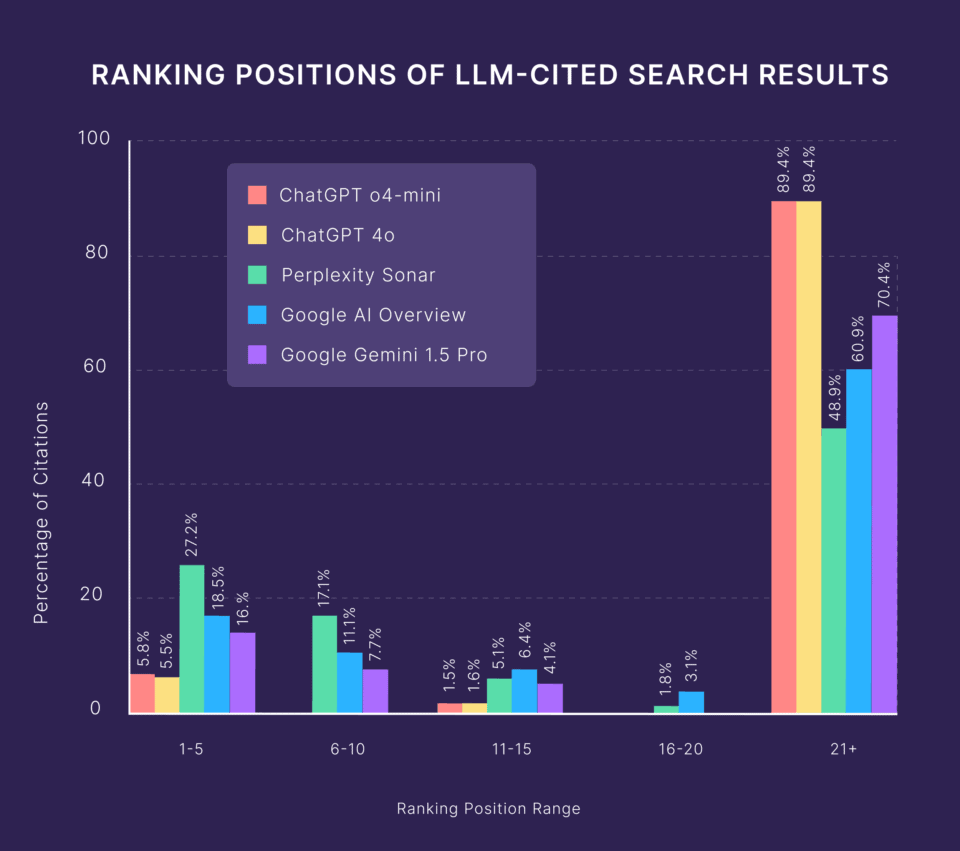
It says most sources cited in AI responses do not even rank in Google’s top 20, and argues that startups can still earn visibility if they follow the right best practices.
That sounds bold, but it lines up with Semrush’s research too, which found ChatGPT frequently cites pages ranking 21+ in traditional search.
Classic SEO still matters. A lot.
But AI results can reward relevance and clarity at the page or paragraph level, not just raw domain muscle.
That is good news for independents.
If you have a genuinely helpful page answering a real local question, you have a shot.
The local advantage is not brand size. it is relevance
Big brands are often broad.
Local businesses are naturally specific.
That is your edge.
A local accountant can create better content for “year end bookkeeping for a cafe in Galway” than a giant national finance site.
A local dentist can answer “what to do if a tooth cracks on a Sunday in Cork” better than a generic health directory.
A local pub can explain “best Sunday roast near Waterford with parking and gluten free options” better than a faceless listicle.
AI search loves that kind of specificity because users love it.
Pew found that longer searches and question style searches are much more likely to trigger AI summaries.
In their study, only 8% of one or two word searches showed an AI summary, but 53% of searches with 10+ words did.
Searches beginning with question words like who, what, when and why triggered summaries 60% of the time.
What local search queries look like as prompts
Here is the practical bit.
Old local search was often short and blunt.
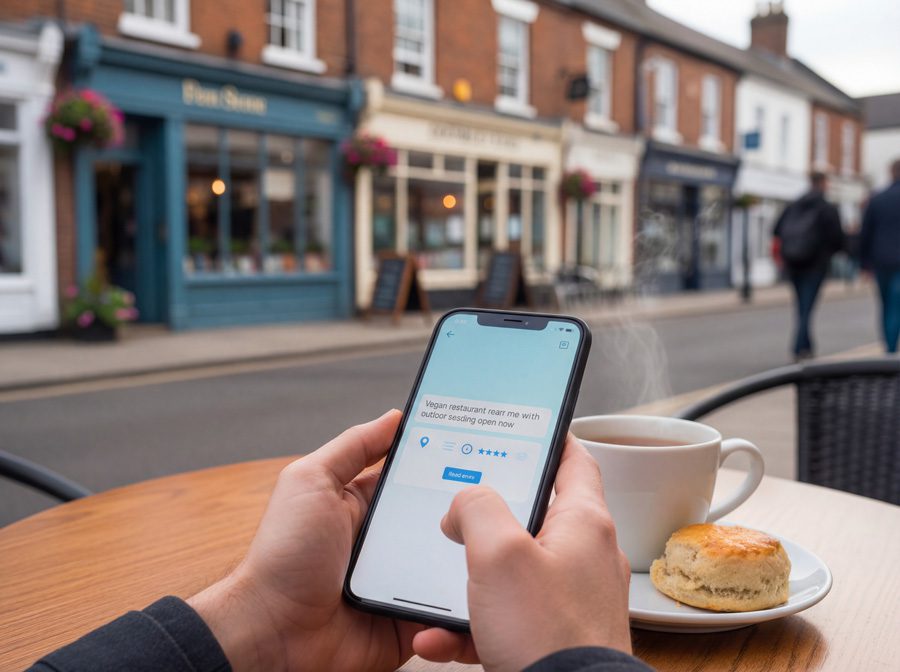
New local search prompts are often conversational and full of conditions.
Let’s take a look…
Trades
Old search: Emergency plumber near me
Prompt version: “I need an emergency plumber in Limerick tonight for a leaking pipe under the sink. Who can come after 6pm and what should I do before they arrive?”
Professional Services
Old search: solicitor family law Sligo
Prompt version: “Can you recommend a family solicitor in Sligo for a first consultation about child arrangements, and what documents should I bring?”
Hospitality
Old search: Italian restaurant Wexford
Prompt version: “Best Italian restaurant in Wexford for a birthday dinner, vegetarian friendly, not too expensive, and easy parking nearby.”
Health
Old search: dentist open Saturday
Prompt version: “Is there an emergency dentist in Killarney open on Saturday morning for a broken filling, and do they accept new patients?”
Home Improvement
Old search: kitchen fitter Athlone
Prompt version: “Who are the best rated kitchen fitters in Athlone for a small galley kitchen, and how long does a typical install take?”
See the pattern?
It is still local SEO, but with more context:
- User
- Location
- Urgency
- Budget or constraints
- Trust signals
- Desired outcome
That is why small businesses can do well here.
You already answer these questions every day on the phone.
Now you just need to answer them on your website too.
The catch nobody should ignore
There is a catch.
AI visibility can reduce clicks.
Pew found users were less likely to click traditional results when an AI summary appeared, and clicks on links inside the AI summary itself were rare.
In their dataset, traditional result clicks were 8% on pages with AI summaries versus 15% without, and only 1% clicked links in the AI summary.
So this is not a promise of instant traffic spikes.
It is a visibility shift.
You may get fewer clicks on some informational searches.
But the clicks you do get can be more qualified, especially when they come from high intent local prompts.
Google also says AI feature traffic is included in normal Search Console web reporting, so you can track this in your existing setup.
In other words, do not chase vanity traffic.
Chase better enquiries.
What this means for local trades, professionals and hospitality
Trades
AI search is great at “problem plus urgency” queries.
That means local trades should create pages and FAQs around common emergencies, timelines, prices, and service areas.
Not just “Plumbing Services”.
More like:
- There’s a leak in my kitchen
- Low boiler pressure
- Emergency callout areas we cover in [town]
Clear, practical content wins here.
Professionals
Professional services can benefit from “explain and reassure” prompts.
People ask AI questions they might not ask in public.
They want plain English.
Solicitors, accountants, mortgage brokers, clinics, consultants. This is your lane.
Create content that answers:
- Who this service is for
- What happens in the first appointment
- What it costs or what affects cost
- What paperwork is needed
- How long it takes
That kind of content earns trust before the enquiry.
Hospitality
Hospitality is where prompts get very specific very quickly.
People now ask for combinations:
- Cuisine
- Occasion
- Dietary needs
- Atmosphere
- Venue Capacity
- Group Bookings
- Distance
- Parking
- Opening times
If your site and profile do not clearly state those details, AI has less to work with.
AI Search checklist for smaller businesses
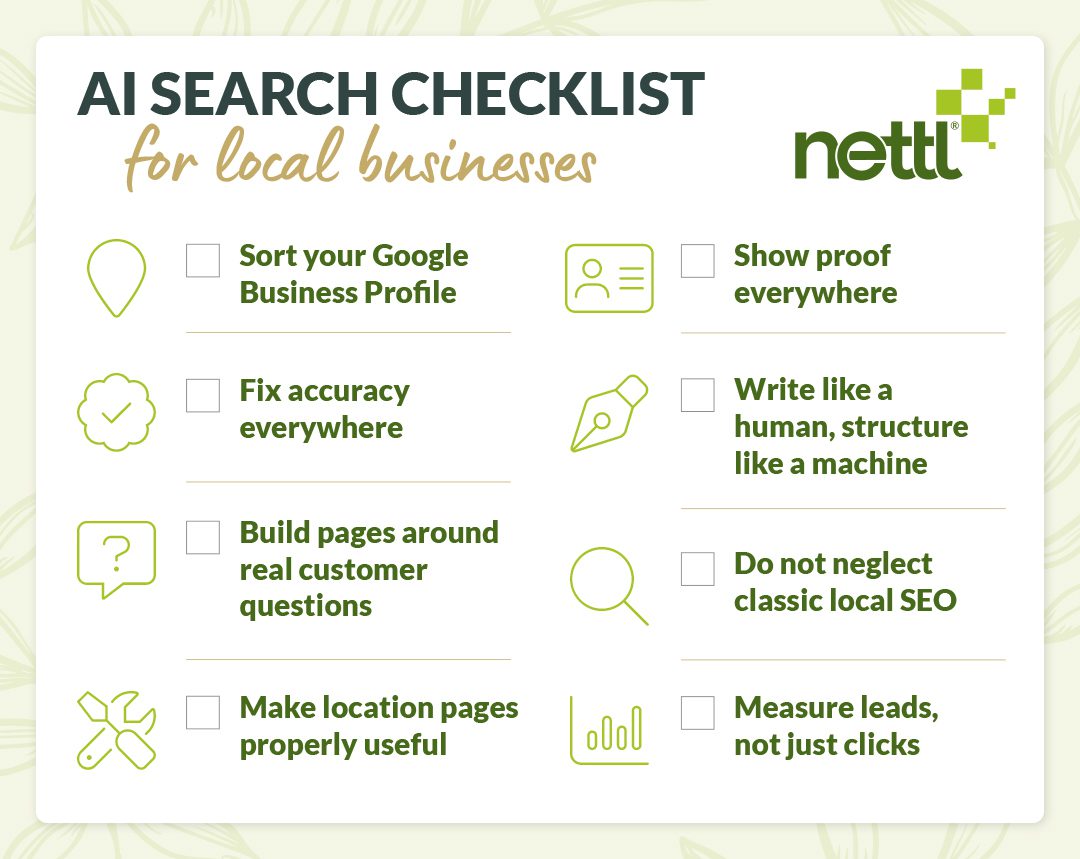
Here is the no nonsense, no fluff, zero tech version.
Sort your google business profile first
Google explicitly says to keep Business Profile info up to date, and that local ranking is mainly based on relevance, distance and prominence. It also calls out complete consistent business info, reviews and review responses as important signals.
Fix accuracy everywhere
This is not glamorous, but it matters. BrightLocal reports 62% of consumers would avoid a business if they found incorrect info online. Wrong opening times alone can cost you the lead.
Build pages around real customer questions
Think about FAQs on steroids. Use your call logs, emails, and sales chats. If people ask it often, write it. If people think it before they contact you, write it.
Make location pages properly useful
Not doorway pages. Real pages. Include areas covered, common jobs, timings, FAQs, parking, service process, and proof.
Show proof everywhere
Reviews, photos, before and afters, accreditations, case studies. BrightLocal also reports 68% of consumers only use businesses with 4 stars or more.
Write like a human, structure like a machine
Clear headings. Short answers first. Details below. Google says AI features still rely on strong fundamentals like crawlability, text content, page experience, and accurate structured data.
Do not neglect classic local SEO
This is not either or. It is both. Map Pack still matters. BrightLocal cites data showing strong click share on local map results.
Measure leads, not just clicks
Track calls, direction requests, bookings, and form quality. AI search may change traffic patterns, but it can still improve lead quality.
So, is AI optimisation just for big brands?
Nope.
Big brands still have advantages. Of course they do.
But AI search is creating a new opening for local businesses that are specific, trustworthy, and genuinely helpful.
That is the opportunity.
Not shortcuts. Not hacks. Not overnight wins.
Just a better reward for being the clearest answer to a real local question.
And if you want the broader foundations too, check out our existing AI SEO guide for the bigger picture.
That said, the lions share of actual business still comes via Google Search. So don’t let your AI pursuits neglect your SEO efforts.
Need help navigating all this? Take a look at our Nettl SEO packages.